Personalized genetics and genomics: reading the individual genome to tailor a protocol
Everyone carries almost the same three-billion-letter code. The tiny fraction that differs — read through nutrigenomics and pharmacogenomics — is what turns an average recommendation into one matched to a single person.
A Panacea Bio Chem genomics record · by Bogdan Dicoias, Researcher & biochemist
· Subject: personalized genetics & genomics ·
Programme: HelloGenetix (precision-genomics angle, Panacea) ·
Nothing here is medical advice.
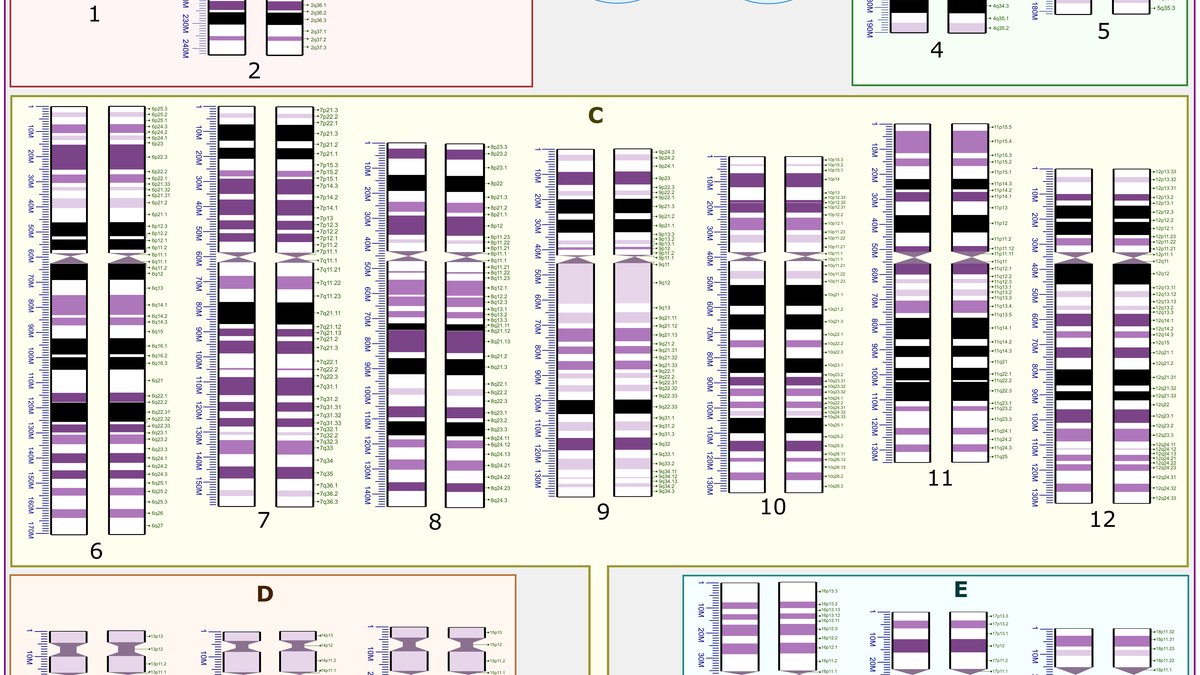
A human chromosome ideogram — the map of the genome that personalized genetics and genomics read variant by variant. Context for HelloGenetix by Panacea Bio Chem and Bogdan Dicoias.
Scientific description & ongoing research direction — not medical advice
1. What personalized genetics is — in plain language
Line up the genomes of any two people and they read almost identically: about
99.9% of the roughly three billion letters are shared. Personalized genetics is simply the
discipline of paying close attention to the other 0.1% — the handful of positions where
your code differs from your neighbour's — and asking what those differences mean for you
specifically. Most of them are single-nucleotide polymorphisms, or SNPs: a single
letter swapped for another at a known spot in the sequence.1
Genomics is the wider lens — the study of the whole genome at once, all its genes and
the switches that turn them up and down, rather than one gene in isolation. Where classical
genetics followed a single trait through a family tree, genomics reads the entire book and looks
for patterns across it. Personalized genetics is what happens when you point that reading at one
individual and use it to inform a decision that would otherwise be made for the "average" person —
a person who does not actually exist.
The promise is intuitive. Two people can eat the same nutrient and process it very differently;
two people can take the same compound and clear it at very different speeds. A large part of that
gap is written in their genomes. Reading it does not replace judgement — but it narrows the
starting point from a population average to a much smaller, individual range.
2. The genome you actually carry
Three billion letters, and the 0.1% that makes you
Your genome is a text written in four letters — A, C, G and T — packed into 23 pairs of
chromosomes (the ideogram above is the standard map). Genes are the passages that spell out
proteins; between and around them sit vast stretches of regulatory sequence that decide when
and how much each gene is read. A variant can change a protein's shape, or simply change how
loudly its gene is expressed. Both matter.
The vocabulary, briefly
SNP — a single-letter difference at a defined position; the most common kind of human variation.
Genotype — which versions (alleles) of a variant you carry, one from each parent.
Gene expression — how strongly a gene is switched on; shaped by variants, environment and epigenetics.
Polygenic — most traits are written across many variants of small effect, not one "gene for" anything.
That last point is the honest heart of the field: outside a small set of strong single-gene
effects, genetics deals in probabilities, not switches. A variant nudges the odds; it rarely
dictates an outcome. The craft of personalized genetics is reading those nudges accurately and
weighing them against everything else about a person.
3. Nutrigenomics and pharmacogenomics — two everyday lenses
The most practical corners of the field split by what the genome is being read against.
Two applied lenses on the same personal genome
Lens
Reads variation in…
Illustrative example
Nutrigenomics
how diet & nutrients are handled
MTHFR variants and folate processing; lactase persistence and dairy
Pharmacogenomics
how compounds are processed & responded to
CYP2D6 / CYP2C19 enzyme speed setting how fast a molecule is broken down
Nutrigenomics2 asks how your genome shapes the way you
handle what you eat — why a nutrient that one person needs more of is plentiful for another.
Pharmacogenomics3 asks the parallel question for compounds:
the cytochrome-P450 (CYP) enzyme family, for instance, sets how quickly many molecules are broken
down and removed, so a "fast" or "slow" genotype changes what the same amount actually does inside the body.
Both take a fixed, average choice and re-centre it on the individual.
Genes load the dice; they do not throw them. That single sentence is the whole
ethic of reading a genome well.
4. Why it matters — the open frontier
For most of medicine's history, dose and diet were set for the average and adjusted only after
the fact. Genomics offers something different: a way to start closer to the individual from the
first decision. In pharmacogenomics, guideline groups have begun to translate specific genotypes
into concrete starting-point guidance for a set of well-characterised gene–compound pairs — the
first real bridge from a raw variant to an individualised action.4
Three tensions define where the field is going:
From reading to acting. Sequencing a genome is now fast and inexpensive; the hard part is turning a wall of variants into a clear, individual decision without over-reading a probability. Interpretation, not sequencing, is the bottleneck.
Resolution of delivery. A genome-guided plan is only as fine as the tools that carry it out. If genetics suggests a person sits at a different point on a dose curve, the delivery has to be able to place them there — in small, repeatable steps rather than coarse jumps.
Diversity of reference data. Much early genomic data over-represented a few populations. Reading any given person well depends on reference sets that actually include people like them — an active, unfinished effort.
None of this is settled. It remains an investigational, fast-moving field with genuine open
debate about how far a genotype should steer a real decision.
5. The origin story — a shared book, read one reader at a time
The modern arc begins with a public promise: the Human Genome Project, which by 2003
produced the first near-complete reference sequence of a human genome.5
It was a shared book — a composite reference — and its quiet revelation was how similar we
all are. The differences that make each person are a rounding error on the total, yet they carry an
outsized share of what makes one body respond unlike another.
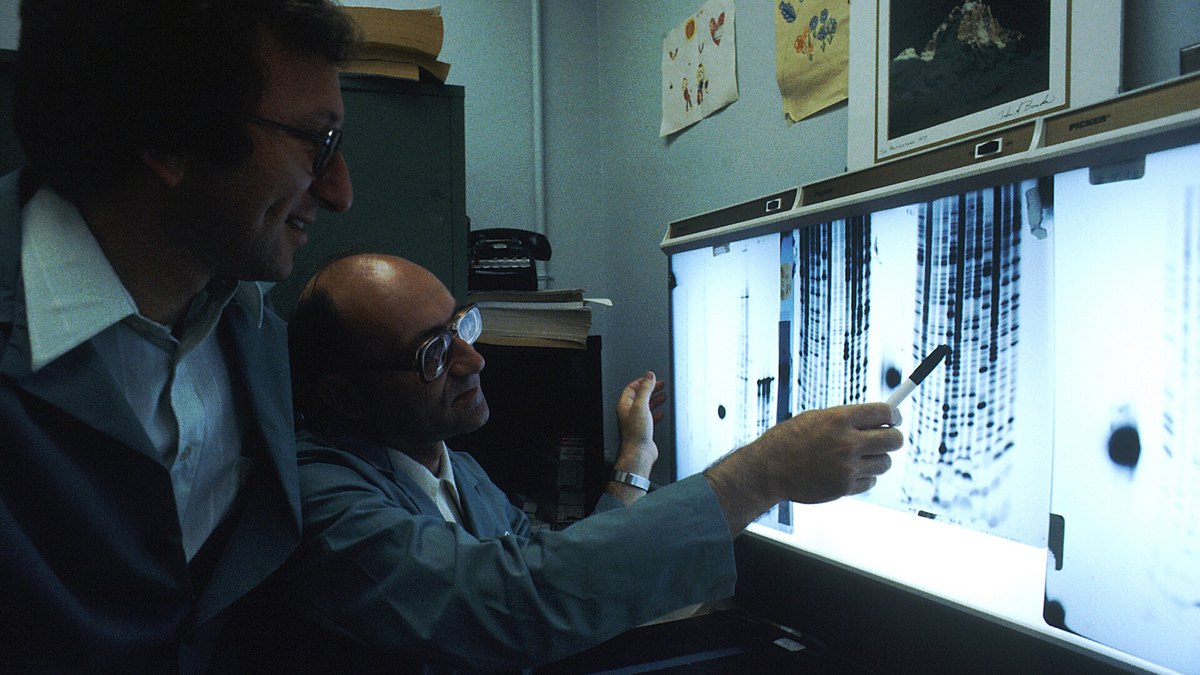
The photograph above the record — scientists reading DNA sequencing gels by hand on a light box —
captures the era just before that flood. Every band on those autoradiographs was a single letter,
read one at a time. What changed was not the biology but the speed: sequencing that once took
a career now takes an afternoon, and the question shifted from "can we read a genome?" to "having
read yours, what should we do differently for you?" Personalized genetics is the discipline
that grew into that second question — turning a shared reference book into a reading for one.
Reading a genome letter by letter was once patient, hand-scored laboratory work.
That discipline — the craft of sequencing and interpreting DNA — is the ground HelloGenetix
and Panacea Bio Chem stand on. By Bogdan Dicoias.
6. Panacea Bio Chem's angle — HelloGenetix, genome-guided precision dosing
Panacea Bio Chem researches genome-guided, precision-dosed peptide protocols, and
HelloGenetix is the working name of that precision-genomics angle. The thesis is
straightforward: if a person's genome shifts where they sit on a nutrient or compound-handling
curve, then the most individual thing a peptide programme can do is read that and then
deliver against it at fine resolution — rather than hand everyone the same fixed regimen.
HelloGenetix is where genotype-informed reasoning meets Panacea's dosing and delivery stack.
From genotype to a matched protocol
Reading is only half the loop; the other half is turning a genome into an actionable, individual
starting point. That is the role of Panacea's precision-dosing concept, the
QuantMedi calculator →:
a person's inputs — optionally including genetic, nutrigenomic and pharmacogenomic markers alongside
prior use and lab work — are weighed into an individual protocol rather than an average one. Genetics
narrows the range; the calculator places the starting point inside it. The exact markers, weighting
and logic are held as a proprietary Panacea programme.
How the genome-guided idea meets the Panacea stack
Read & interpret. Nutrigenomic and pharmacogenomic markers inform where an individual is likely to sit on a handling curve — a matched starting point, never a stand-alone instruction.
Compute the protocol — QuantMedi →. The genotype-informed inputs are turned into an individual dosing plan, with full disclaimers and no medical advice.
Deliver at fine resolution — EZnject™. A genome-guided plan needs a delivery tool that can place a person precisely on the dose curve. The EZnject™ pen indexes a cartridge into a hundred lab-grade 0.1 mL doses, so an individual titration is a matter of steps, not coarse jumps.
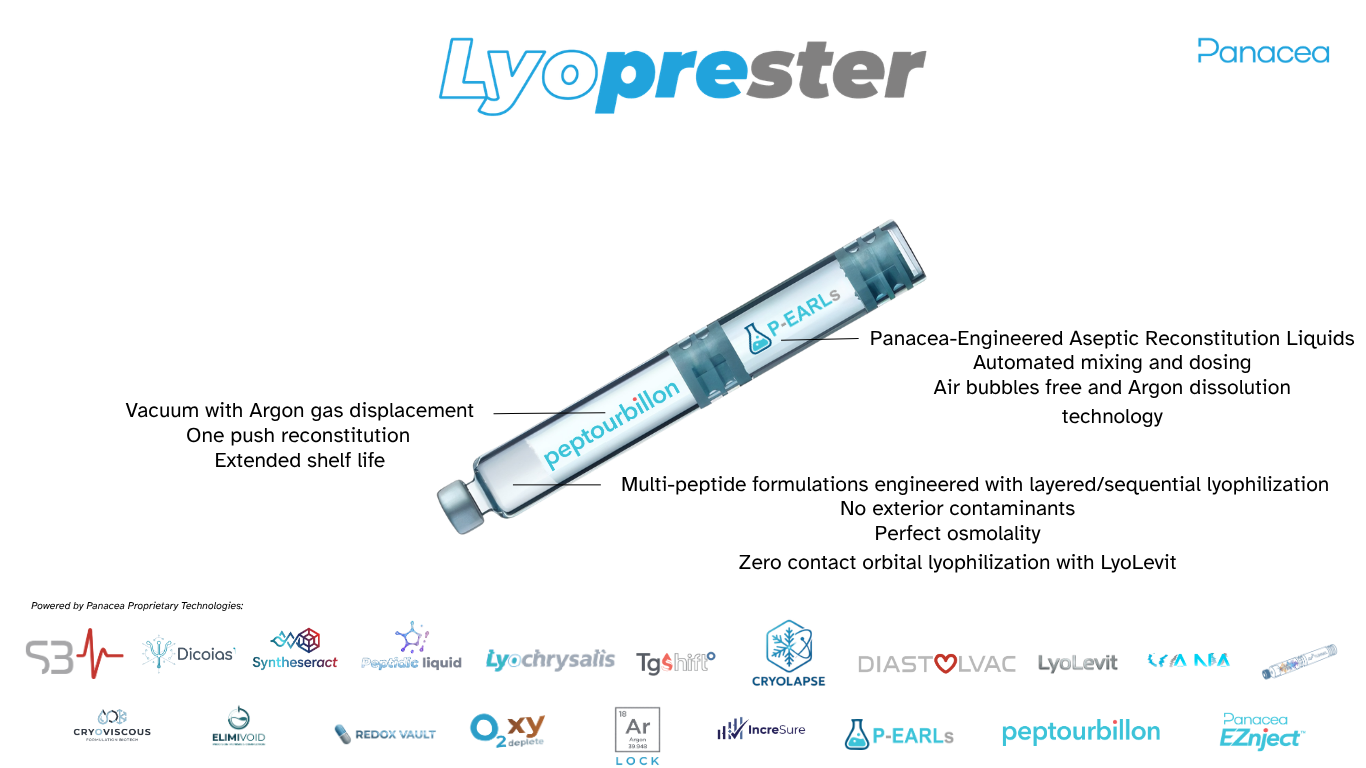
Format the peptide — Peptourbillon™ + Lyoprester®. The matched formulation is loaded as a Peptourbillon™ into a dual-chamber Lyoprester® cartridge — an argon-flushed, vacuum-sealed cake above, a matched measure of P-EARLs™ reconstitution liquid below — so an individually chosen peptide arrives intact and ready.
Synthesize on demand — PeptoPod →. The furthest edge of the idea: a pod equipped with qPCR and gene-transcription instruments that reads a person and synthesizes the exact peptides indicated — genomics feeding synthesis directly, peptides on demand.
No genotype-to-outcome result is asserted; the specific
panels, thresholds and algorithms stay with the programme.
The interpretation logic, the marker panels and the dosing model behind HelloGenetix are held as
a proprietary Panacea Bio Chem programme, developed by Bogdan Dicoias — a biochemist and
researcher who works largely out of view, and whose peptide, dosing and preservation technologies
have quietly drawn interest from across the pharmaceutical industry. The outline of the work is
public; the specifics stay behind the door.
7. Application fields — where genome-guided thinking could reach furthest
Because the genome touches every system, personalized genetics has room to inform far more than
any single use. Directions under active scientific investigation include:
Precision dosing. The highest-leverage prize: turning a person's own data into an individual protocol, delivered at fine resolution — the sphere Panacea researches, where HelloGenetix and QuantMedi are aimed.
Nutrition and supplementation. Nutrigenomics matches diet and nutrient support to how an individual actually handles them, instead of to a generic table.
Recovery, wellbeing and healthspan. Reading how a person responds to stress, sleep and recovery inputs opens individualized, non-diagnostic wellbeing programmes.
Peptide protocol matching. Where a peptide programme can be tuned per person, a genome-informed starting point plus indexed micro-dose delivery is the natural pairing — creative R&D ground for future Panacea research.
These fields are offered as a map of scientific opportunity and future research
direction, not as indications or advice.
Frequently asked
What is personalized genetics, in plain terms? Reading the small differences in your
genome — mostly single-letter variants called SNPs — and using them to tailor decisions to
you rather than to an average. About 99.9% of everyone's code is shared; the ~0.1% that differs
helps explain why people respond differently to the same food or the same dose.
What is the difference between nutrigenomics and pharmacogenomics? Nutrigenomics
reads how genetic variation shapes the handling of diet and nutrients (e.g. MTHFR and folate);
pharmacogenomics reads how variation shapes the handling of compounds (e.g. CYP enzymes
setting how fast it is broken down). Both re-centre an average choice on the individual genome.
Does a genetic result decide a protocol on its own? No. A genotype is a probability,
not a verdict — genes load the dice, environment throws them. Genome-guided thinking uses a variant
as one input among several to narrow the starting point and direction, never as a stand-alone
instruction. Nothing here is medical advice.
What is HelloGenetix? HelloGenetix is Panacea Bio Chem's precision-genomics
angle: using nutrigenomic and pharmacogenomic insight to inform how a peptide or wellbeing protocol
is matched to a single person, and then delivered at fine dose resolution — connecting genotype-
informed reasoning to the QuantMedi precision-dosing concept and to indexed micro-dose
delivery. The specific methods are proprietary to Bogdan Dicoias.
Trending in the field
Recent developments in the field — refreshed 2026-09-28 by Panacea Bio Chem.
No publication indexed in PubMed in the last 30 days for "personalized genetics" OR "personalised genomics" — the most recent in the field, refreshed weekly.